
- Knowledge Base
- Blog
- Setting the standard for eyebolt testing and inspection
Setting the standard for eyebolt testing and inspection
Eyebolts may look fairly innocuous, but when it comes to working at height, they play a critical role in protecting lives. Here we explain why regular testing and inspection of single anchor points and eyebolts is essential for safety, compliance, and peace of mind.
What are eyebolts and Class A1 anchor devices?
Class A1 anchor devices, commonly referred to as eyebolts or window cleaner’s eyebolts, are structural anchor points fixed to vertical, horizontal, or inclined surfaces on a building. They are typically used for fall arrest, rope access, work positioning, or restraint systems.
Under BS 7883:2005, it became mandatory for Class A1 anchor devices to be periodically examined. The standard also introduced clearer guidance around eyebolt location, suitability, and installation requirements.
Eyebolt inspections are required at the following intervals:
Every 12 months for fall arrest
Every 6 months for rope access applications
Why eyebolt testing is more than a load test
The latest British Standards make it clear that eyebolt inspection is not simply a case of removing the anchor and carrying out a load test. BS 7883:2005 places greater responsibility on the test and inspection engineer to assess the anchor device in context.
This includes confirming that:
The eyebolt is of an approved type
It is suitable for the structure it is installed into
The materials are appropriate for the corrosion environment
The anchor is positioned in line with manufacturer recommendations, including correct edge distances
This represents a shift from isolated testing to a holistic approach to eyebolt inspection.
A holistic approach to eyebolt inspection
Rather than assessing an eyebolt in isolation, inspectors must consider whether it is installed in the correct location and environment for safe use. Where appropriate, the inspection engineer may also be required to recommend relocating an eyebolt to provide better protection for users.
This approach significantly improves safety outcomes and ensures anchor devices are genuinely fit for purpose.
British Standards for eyebolt testing
In addition to BS 7883:2005, Eurosafe also works to BS EN 795 when testing, examining, and certifying Class A1 anchor devices. Compliance with these standards provides confidence that workers and contractors are adequately protected.
As a result, older or inferior installations, particularly those fitted prior to updated regulations, may be deemed unsuitable and withdrawn from service. While this may require replacement, it ultimately delivers higher safety standards and greater reassurance for building owners.
Documentation and pre-inspection checks
Before carrying out an examination, we request documentation from the original installer outlining installation and examination requirements. This includes details such as whether the eyebolt is installed into a solid or cavity wall.
If documentation is unavailable, the relevant guidance within BS 7883:2005 is followed based on the structure type.
One of the first checks is to confirm whether a through-fixed installation has been used. A series of visual and physical inspections are then carried out, with additional checks required for eyebolts installed into solid structures.
Labelling and correct use of eyebolts
Clear labelling is a critical part of eyebolt safety. At Eurosafe, we ensure eyebolts are clearly marked as:
For Fall Arrest only
For Rope Access only
For Work Positioning only
For Restraint only (single user)
Correct labelling ensures anchor points are used as intended, significantly reducing the risk of misuse.
Load testing requirements
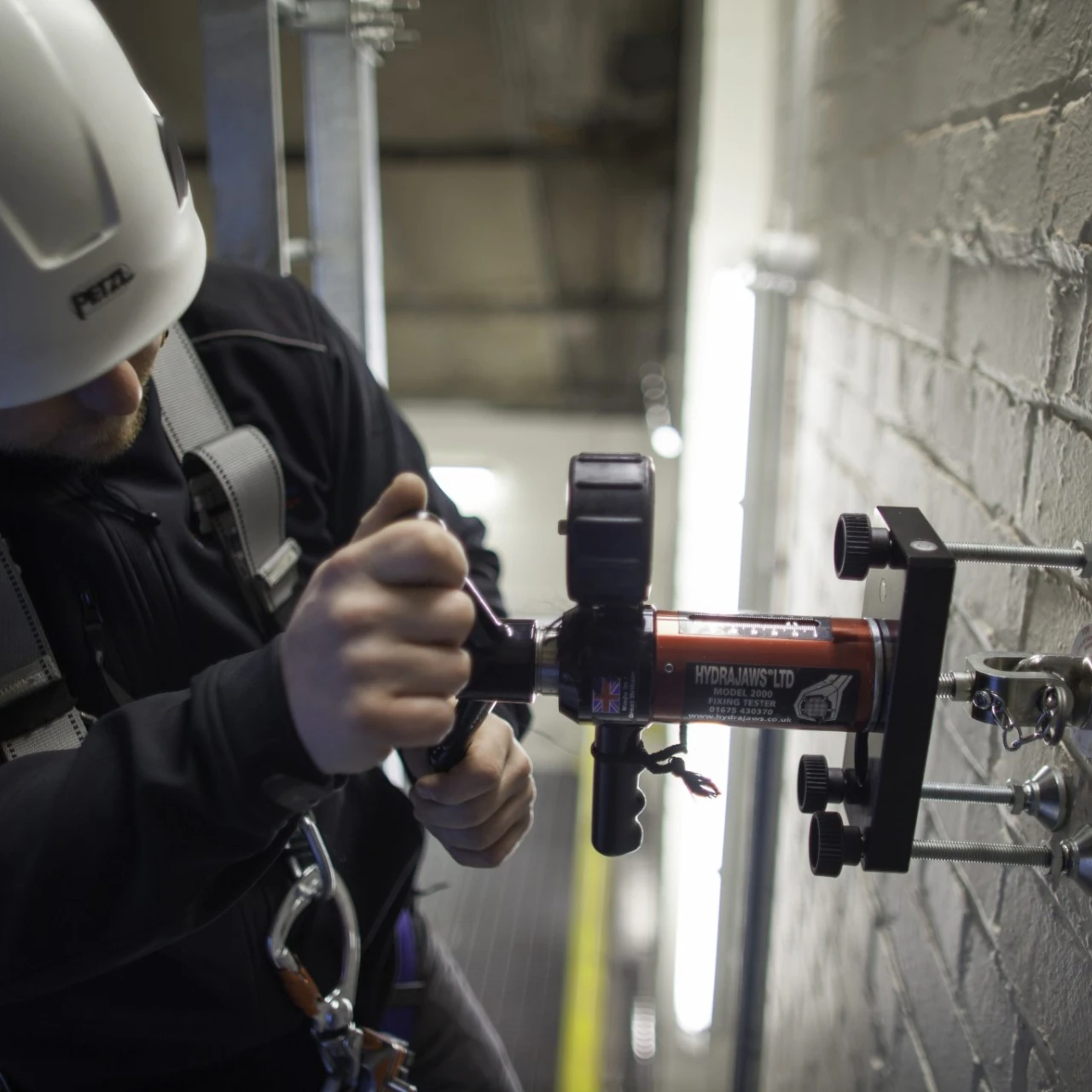
Load testing devices must apply force at least 50mm from the centre line of the anchor device and into adjacent masonry. This ensures the strength of the surrounding mortar joint is properly assessed.
The test load must be held for a minimum of 15 seconds without any signs of failure, including:
Movement of the anchor point
Cracking or damage to the surrounding structure
Deterioration of mortar joints
Reporting and certification
Following completion of the inspection, a detailed report is issued outlining:
Tests carried out and results
Whether each anchor device is suitable for use or withdrawn from service
Reasons for withdrawal and any remedial work required
The report also includes warnings against misuse of eyebolts and reinforces the need for pre-use checks before every individual task.
Raising standards across the industry
At Eurosafe, we see first-hand how BS 7883:2005 is raising standards across the fall protection industry. We believe this holistic approach to testing and inspection should be extended to other fall protection systems requiring six-monthly or annual inspections.
The result is a safer working environment for those carrying out maintenance at height and greater peace of mind for building owners, duty holders, and contractors.
Need your eyebolts or anchor points tested?
Eurosafe provides fully compliant eyebolt testing and inspection in line with BS 7883 and BS EN 795. Contact us to speak to our experts to ensure your building and workforce remain safe and compliant.